
Devices
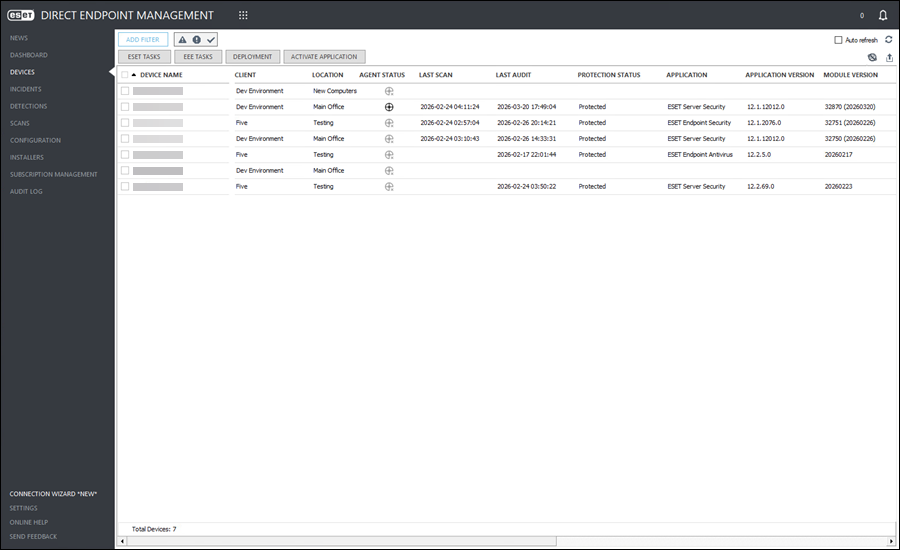
View, filter and export a list of managed devices. See the list of available tasks to be sent by the plugin to the selected managed device.
Click the Refresh  icon to update the list with the most up-to-date data. (Optional) Select the check box next to Auto refresh for automatic update of the data.
Tasks
Right-click the row with the desired device. The following actions are available (based on application status and other prerequisites):
|
Monitor task execution Use the plugin audit log to monitor task execution details. |

Device name |
|
|
Device details collected by the plugin for the managed device. |
|
Open ConnectWise Automate Computer Management Screen. |
|
Open device details in the ESET PROTECT Web Console. |
|
Send ConnectWise Automate Refresh System Info command to the managed device. |
|
Select one of the available installers from the drop-down menu for deployment on the managed device. |
|
Select one of the available subscriptions from the drop-down menu to activate of the managed device. |
ESET Tasks |
|
|
Configure scan profile and scan targets, and send an on-demand scan task request to the managed device. |
|
Send the module update command to the managed device. |
|
Send the resend policy command to the managed device. |
|
Send the clear protection status command to the managed device. |
|
Send the application deactivate command to the managed device. |
ESET Endpoint Encryption Tasks |
|
|
Configure and send ESET Endpoint Encryption (EEE) maintenance mode command to the managed device. |
|
Configure Full Disk Encryption options and send the encrypt disk command to the managed device. |
|
Send the decrypt disk command to the managed device. |
|
Launch the encryption recovery wizard to recover lost access to the encrypted managed device. |
|
Change ESET Endpoint Encryption username. |
|
Change ESET Endpoint Encryption password. |


Show device details
•Overview—Displays all available database information from the plugin for the selected managed device. Click Tasks for the list of available actions.
•Detections—Displays list of detections from the last seven days for the selected managed device.
•Scans—Displays list of scans from the last seven days performed on the selected managed device.
•Events—Displays list of plugin-related events from the last seven days performed on the selected managed device.
•Policies—Displays list of assigned policies for the the selected managed device.
On-Demand scan
1.Right-click the row with the desired detection. Select the On-Demand Scan option.
2.In the next window, click the Scan profile drop-down menu to select the desired scan profile.
3.(Optional) If you select Custom profile in step 2, you can type (case-sensitive) custom settings into the Custom Profile text field.
4.Select Scan targets, click check box next to the desired line item.
5.Click OK.
Filter table data
To filter data, click Add Filter and select the applicable value from the drop-down menu.
Various filters allow editing, for example, the Client, Location, Device Name, etc. Adjust the filters using the appropriate drop-down menu or type the value.
Click the x next to the filter to remove it.
Available filters:
•Client
•Location
•Device Name
•Agent Status (Online)
•Plugin Controlled
•Application
•Application Version
•Protection Status
•Audit Date
•Last Scan Date
•Never Scanned
•Subscription
•Module Version
•EEE Plugin Controlled
•EEE Status
•EEE Version
•EEE License
Filter by severity
Click a Severity icon— Critical,
  Warning or
  Info. You can combine these icons by enabling or disabling them.
Sort table data
All tables can be filtered and sorted by any column. To easily sort by ascending/descending order, select the applicable column header. For additional filters and sorting options, right-click the column header.
Group table data
In the desired table column, right-click and select Group By This Column. All items will be grouped by the selected column header.
Click the Clear Column Grouping  icon to remove any table column grouping.
Export table data
To export the filtered table data, click the Export Table  icon, and in the next window, type the File Name. Click Save to create the export file in the .csv format.